

The Corporate Sustainability Reporting Directive (CSRD) came into force on January 5, 2023, creating a uniform framework for reporting non-financial data in the European Union. Many medium-sized companies are therefore faced with the challenge of submitting a sustainability statement for the first time.
The European Sustainability Reporting Standards (ESRS) define the content of the new disclosure requirements. They will come into force gradually from 2024, including the concept of double materiality. In this blog post, we want to explain this fundamental concept and show how a double materiality analysis can be mastered simply and effectively using the Code Gaia method.
Table of contents
- What is the double materiality analysis?
- Why is the double materiality analysis important?
- When is information considered material in the double materiality analysis?
- How does the Code Gaia approach to double materiality analysis work?
- Summary
1 What is the double materiality analysis?
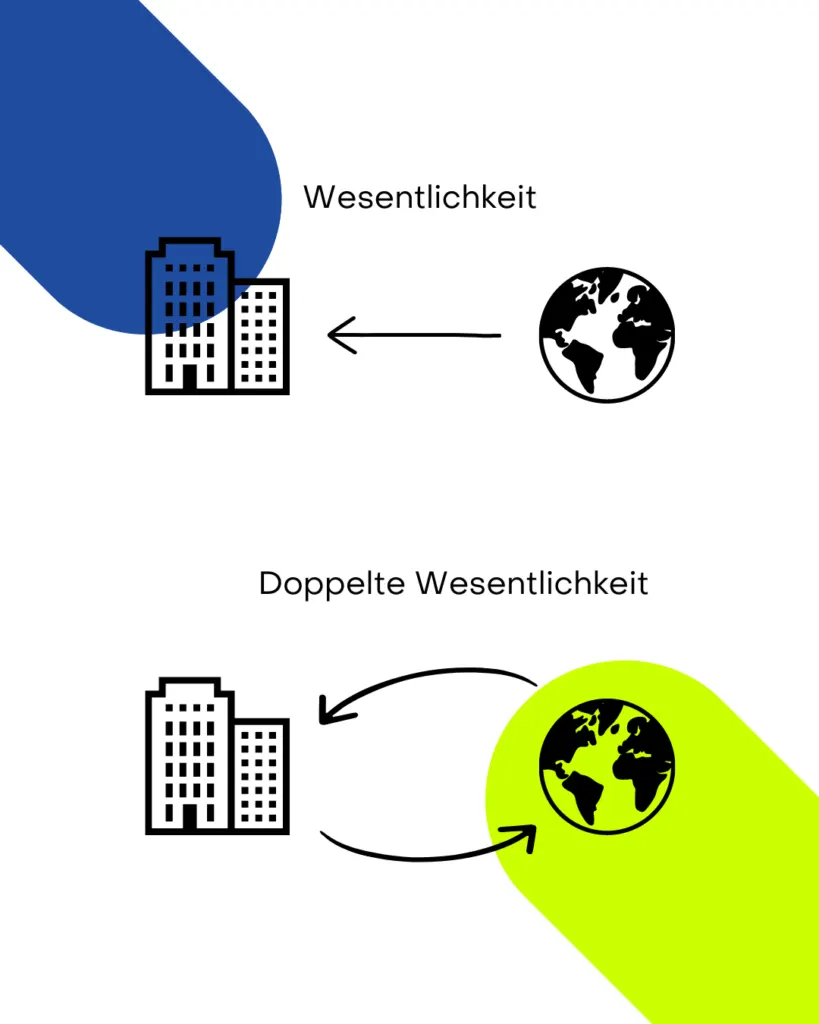
The concept expands the decision-making criteria for the inclusion of sustainability aspects in company reports. This assessment determines both the impact of your company on the environment and society and the impact of environmental and social issues on your company. The concept forms the basis for your ESRS-compliant reporting (ESRS 1, sections 3.4 and 3.5).
An assessment of double materiality influences the scope and detail of the information that must be disclosed in a sustainability statement. Double materiality is the combination of “financial materiality” (the impact of the environment on a company’s financial performance) and “impact materiality” (the company’s impact on society and the environment).
2 Why is the double materiality analysis important?
The concept of double materiality ensures that reporting is not one-sided. This means that aspects that have a negative environmental impact but no negative financial impact on the reporting company are still subject to reporting. This was not previously the case under the Non-Financial Reporting Directive (NFRD).
Previous materiality principles related exclusively to the impact of sustainability factors on finances and corporate activities (outside-in), which emphasized the interests of investors and stakeholders. However, double materiality goes further and also takes into account the impact of financial and corporate activities on sustainability aspects (inside-out), which gives greater importance to the interests of stakeholders or “silent stakeholders” (nature). Double materiality thus expands the scope of factors considered material for sustainability.
Start double materiality analysis with Code Gaia
3. when is information considered material in the double materiality analysis?
Information is considered material for the primary users of general financial reporting if it can reasonably be expected that the omission, misrepresentation or concealment of this information could influence the decisions they make on the basis of the company’s sustainability statement. A sustainability aspect is material from a financial perspective if it has a significant financial impact on the company or can reasonably be expected to have such an impact.
4 How does the Code Gaia approach to double materiality analysis work?
The first step is to identify the most important sustainability aspects using the Code Gaia approach to double materiality (a list of all sustainability aspects compiled by Code Gaia can be found here). The approach was developed by Code Gaia in the period from June to December 2023. During this time, it was applied in real cases at companies conducting ESRS-aligned materiality assessments for the first time. The approach therefore draws on this practical experience as well as input from environmental impact assessment (EIA) and accounting theory. A detailed description of the Code Gaia approach with insightful visualizations can be found in our white paper The Code Gaia Approach to Dual Materiality.
The Code Gaia approach uses a four-step process to identify impacts, risks and opportunities (“IROs”) and assess which of these are material. The Code Gaia approach assumes that a four-step process is appropriate in the period before the first reporting year and that these steps can be carried out simultaneously to a certain extent. However, it is advantageous to carry them out one after the other. The steps identified should then be adopted as continuous work processes in subsequent periods.
Tip: In the double materiality analysis with Code Gaia, you and your team are guided step by step through the process of double materiality analysis. Document the entire process and its results directly in our software in an ESRS-compliant manner, without any prior knowledge or time-consuming familiarization with the rules and regulations. Examples and training content, as well as the support of our experts and partners, are available to you. We also offer accompanying workshops on request.
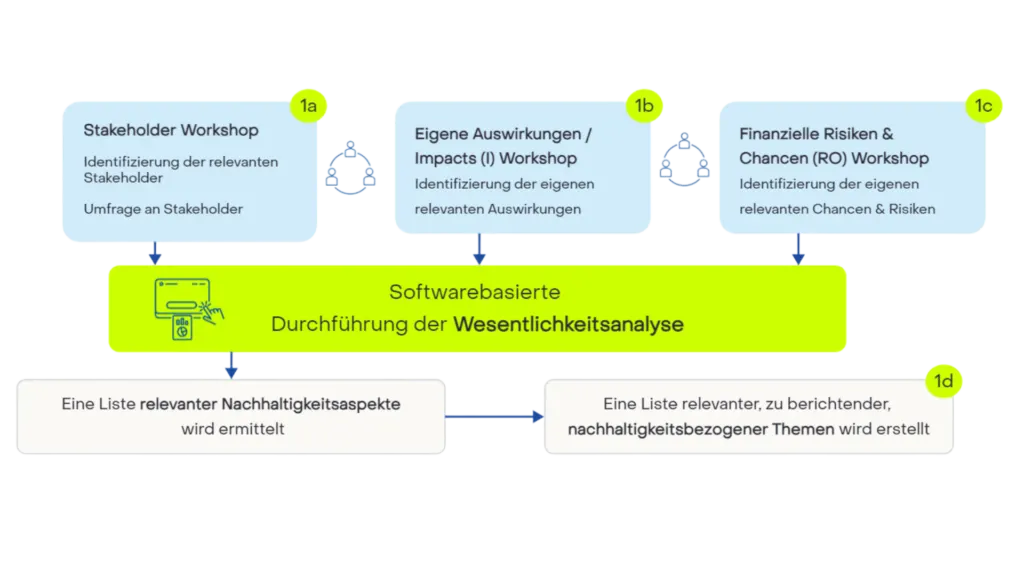
Step 1: Identifying stakeholders and determining the impact on stakeholders
The potential stakeholders are first identified on the basis of the stakeholder categories and criteria defined in the ESRS and experience with sustainability-related stakeholders. Following this identification workshop, the identified stakeholders are actively approached
and asked to provide feedback on the impacts and, if possible, to give their opinion on the nature of these impacts in accordance with the materiality tests set out in the ESRS.
Step 2: Identifying your own impact
In this step, “own impacts” (internally identified impacts) are determined on the basis of the identification criteria defined in the ESRS and experience with sustainability-related topics as well as internal experience and expertise. The results and content of this step are recorded in an internal process document entitled
, which can later be used as the basis for the ESRS sustainability reporting requirements in relation to materiality. Following this impact identification step (see step 4), a final list of impacts is compiled in conjunction with stakeholder feedback and assigned to the relevant sustainability aspects.
Step 3: Identification of financial risks and opportunities
The identification of financial risks and opportunities (risks and opportunities = “ROs”) is based on the following principles
a) based on the criteria set out in the ESRS, in combination with the results of the two previous steps, and
b) experience with sustainability-related topics and
c) the internal experience and expertise within the organization.
Following this identification of risks and opportunities, a final list of ROs is compiled and assigned to the relevant sustainability aspects.
Step 4: Compilation of IROs, materiality assessment and documentation
Once all IROs are collected and mapped to the relevant sustainability aspects, the nature, magnitude, extent, immutability, direction and likelihood characteristics of the impacts are used to determine the materiality of each impact. In addition, the tests for financial materiality are applied to the ROs in coordination with the company’s finance and accounting functions.
Every impact, risk and opportunity that meets the materiality criteria is classified as material and the following topics and aspects are included in the scope of the sustainability statement.
5. summary
The introduction of the Corporate Sustainability Reporting Directive (CSRD) and the associated European Sustainability Reporting Standards (ESRS) has significantly increased the importance of the double materiality analysis for companies. This approach extends the traditional materiality principles by taking into account both the impact of companies on the environment and society and the impact of environmental and social issues on companies.
Double materiality ensures that reporting is not one-sided and that aspects that do not have a direct financial impact but are nevertheless relevant for stakeholders are included in sustainability reporting. The four-step Code Gaia approach provides companies with a structured process for carrying out this double materiality analysis, which is based on practical experience and enables a systematic assessment of impacts, risks and opportunities. By applying this approach, companies can ensure that their sustainability reporting meets the requirements of the ESRS and takes into account the interests of all relevant stakeholders.
Would you like to know whether Code Gaia can also support you with your individual requirements? Let’s find out together .
You can also listen to this podcast episode with Stefanie Höpler in conversation with Code Gaia CEO Markus Adler.
You are currently seeing a placeholder content of Standard. To access the actual content, click on the button below. Please note that data will be passed on to third-party providers.
Unlock content Accept required service and unblock content More information