

Many SMEs are faced with the challenge of ESRS reporting for the first time and are wondering what the process from A to Z looks like for preparing their first sustainability statement.
In this blog, we want to give a brief overview of the various steps in the entire process.
This blog post is a summary of our webinar The Ultimate ESRS Roadmap: From 0 to Final Report – A Comprehensive Step-by-Step Guide from September 25, 2024. Access the webinar series via the button below.
Webinar ansehen
From the CSRD to the ESRS: a brief overview
The basis for the EU’s new sustainability reporting is the Corporate Sustainability Reporting Directive (CSRD), which came into force in 2022. It obliges many companies to publish their sustainability reports together with their financial data. The CSRD is supplemented by the European Sustainability Reporting Standards (ESRS), which set out detailed reporting requirements.
Collaboration in the company: Who needs to be involved?
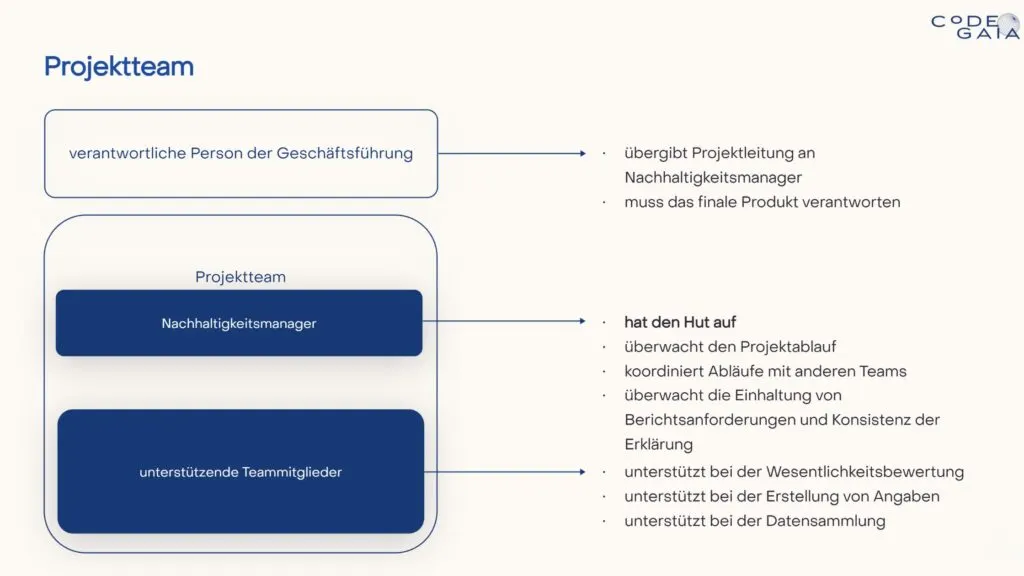
The first step is to appoint a project team. It is important to have a responsible person from the management.
The five steps to the final report
The ESRS reporting process is complex and requires careful planning. We have divided this process into five key steps:
1. double materiality analysis
The first step is the double materiality analysis. It is the starting point for sound sustainability reporting in accordance with the ESRS. It assesses a company’s environmental and social impacts as well as its financial risks and opportunities. A structured approach helps to identify relevant topics and involve stakeholders in the process.
Code Gaia supports this process with workshops, AI-supported analysis tools and automated workflows. The software facilitates the recording and evaluation of IROs, integrates stakeholder feedback and offers methodical support. This enables companies to efficiently determine the relevant report content.
Once the materiality assessment has been completed, the scope of the report must be defined. The Code Gaia software prepares this automatically and allows for subsequent adjustments. Non-relevant information should be excluded at an early stage and justified transparently in order to keep the report focused and compliant with ESRS requirements.
Early work on ESRS 2 helps to set the strategic framework for the report. This standard contains general information on materiality and corporate strategy and can be developed in parallel with the collection of data for topic-specific standards. Structured documentation and close coordination with auditors can further strengthen the credibility of the report.
2. gap analysis
A gap analysis helps companies to align existing sustainability data with reporting requirements and identify gaps in management practices or data collection. Experienced reporters in particular benefit from this, while newcomers should often work directly with the key IROs.
The first step is to review relevant ESG standards in order to record the necessary information and optimize reporting processes. The Code Gaia software facilitates this by integrating all topic-specific standards. A structured gap analysis helps to compare existing ESG data with new requirements, using previous reports as a guide.
In addition, companies should align their existing strategies, measures and objectives with the identified IROs. Cooperation with relevant departments such as compliance, human resources and facility management facilitates the collection of all relevant information.
As many reporting obligations require financial data, coordination with the finance team is essential. The data should match the official company reports to ensure credibility. As financial figures are often not finalized until late in the process, early but flexible planning is necessary.
3. insert information into software and set up procedures for recording
Following the gap analysis, the aim is to anchor existing strategies, measures and targets in the relevant reporting standards. At the same time, previously missing processes and structures for data collection must be integrated. This step is ongoing and develops over time.
An important part of reporting is reviewing existing documents and adapting them to reporting requirements. Code Gaia software can facilitate this process through AI-powered analysis and templates. It is essential that all disclosures focus on the identified IROs to ensure relevance and clarity.
Existing ESG data, for example from previous reports, should be systematically integrated. Reporting tools can be used to automate this process, saving time and avoiding errors. At the same time, the collection of new parameters relevant to ESRS should begin at an early stage, as some processes are designed for the long term.
In addition to data collection, gaps in strategies and measures must be closed. New guidelines should be planned in good time and coordinated with relevant departments. Simply formulating a strategy to fulfill reporting obligations is not sufficient; instead, realistic implementation periods and long-term sustainability goals should be defined.
4. finalize details, add final parameters and finalize monetary contributions
Only in the fourth step is the actual sustainability report written. This is where all the collected data and information must be reconciled. Once strategies, measures and targets have been updated, data collected and relevant information structured, the report details are drawn up in detail. This step requires precise wording and close coordination with various departments.
The qualitative requirements from ESRS 1, Appendix B and the minimum disclosure requirements (MDRs) from ESRS 2 must be observed to ensure consistency and relevance. The measures and objectives identified in the gap analysis should be contextualized in the report without including every detail for different locations or subsidiaries.
Parallel to data collection, available ESG parameters should be integrated at an early stage and compared with the sustainability targets. Approximations or scaling are permitted, but must be documented and explained. Close coordination with the data collection team ensures that all figures are validated before the final submission.
The monetary information must be consistent with the financial reporting, which is why close cooperation with the finance department is essential. Discrepancies should be avoided and the information should be kept consistent to ensure credibility.
At the end, the ESRS 2 disclosures are reviewed to ensure that all relevant information is included and remains consistent with the other disclosures in the report. The final review ensures that quantitative and qualitative disclosures provide a complete and coherent picture of the company’s sustainability strategy.
5. finalization and integration into the management report
In the final phase of the sustainability statement, all content is checked for accuracy, compliance and consistency with the corporate identity. The draft report should be shared with internal control teams and external auditors to avoid errors and ensure quality. As the CSRD requires an external audit, auditors or assurance providers must be carefully selected to meet regulatory requirements. A transparent reporting process with detailed documentation can make the audit much easier.
As soon as the content has been finalized, the design of the report is adapted. This includes both the visual design for the readable version and the technical implementation for digital formats such as XBRL. While design teams ensure the corporate identity, the XBRL tagging process ensures a precise digital submission. Tools such as Code Gaia help with the correct allocation of data points.
The final step is the integration of the sustainability statement into the management report. The CSRD requires close integration with financial reporting so that both areas are presented as part of a holistic corporate performance. This ensures a transparent and consistent presentation of the company’s financial and sustainable development.
Conclusion
With the right preparation, the ESRS process can be managed well. Companies should initiate it as early as possible in order to end up with an audit-proof report.
The Code Gaia ESRS roadmap offers a structured and efficient method to get from the initial analysis to the final sustainability statement. With clear process steps – from the double materiality assessment to the gap analysis and reporting – the roadmap ensures that all ESRS requirements are met. Supported by digital tools, automation and technical expertise, Code Gaia facilitates data collection, report structuring and external auditing. This enables companies not only to comply with regulatory requirements, but also to establish a transparent and credible sustainability strategy.
ESRS Fahrplan herunterladen