

In our last blog post , we explained exactly what the double materiality analysis is and why it plays an important role in sustainability reporting. We also explained the criteria according to which information is considered material in the double materiality analysis and briefly outlined the 4 steps of double materiality according to the Code Gaia method. If you are not yet familiar with these points, we recommend that you read our previous blog post before reading this article.
In this article, we will now go into detail on the first step within the analysis of double materiality according to the Code Gaia method; the identification and involvement of stakeholders.
Workshop to identify and categorize stakeholders
In the first step of the double materiality analysis according to the Code Gaia method, the identification and involvement of stakeholders, an internal workshop or a similar process is usually carried out in the form of a one-off event.
Potential stakeholders are identified on the basis of the identification criteria defined in the ESRS and experience with sustainability-related stakeholders.
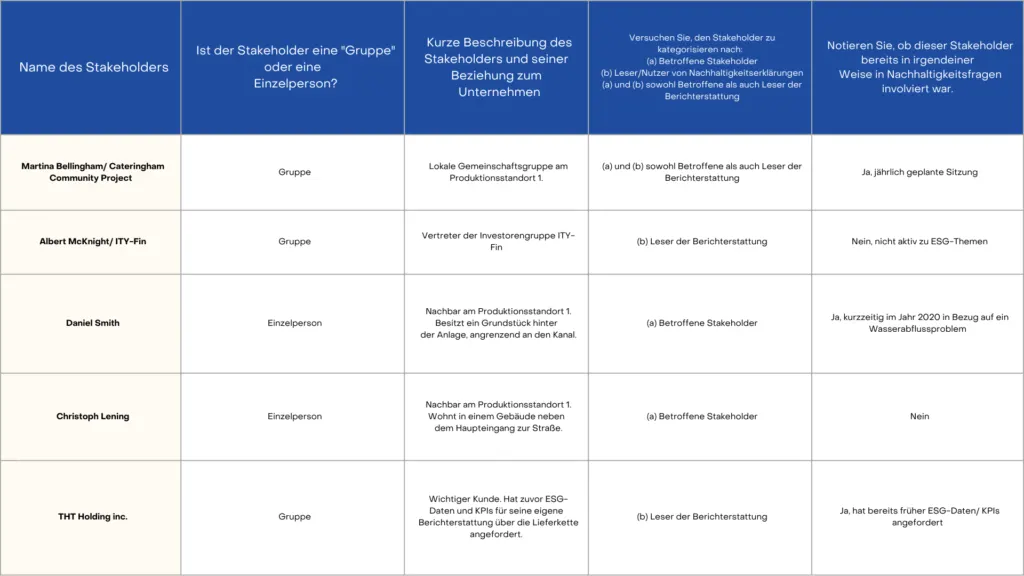
The results and content of this workshop are recorded, with all identified stakeholders categorized and assigned to the stakeholder categories defined in the ESRS:
(a) Affected stakeholders
(b) Readers/users of sustainability statements
(a) and (b) both those affected and readers of the report.
An example of how stakeholders are categorized/assigned in the Code Gaia approach is shown in the following Table 1 – Example of stakeholder assignment.
Definition of impacts by stakeholders
Once the stakeholders have been identified, they receive questionnaires to identify impacts. Stakeholders have the opportunity to describe the impacts in more detail.
A period of two to eight weeks is usually allowed for the responses to this request to be returned. During the participation process, stakeholders are given the opportunity to describe the impact using as many “ESRS impact characteristics” as possible.
However, given the rather technical nature of these characteristics, it is assumed that many stakeholders are not able or willing to define impacts in such detail. Stakeholders may therefore abandon the process of identifying and characterizing impacts at any time. In this case, this would require the impact assessment process step to include some interpretation of stakeholder feedback to fill in any gaps in the characterization provided by stakeholders.
Note on reporting in the first year and “increased inclusion”
The EFRAG 1 recommends that stakeholder engagement includes obtaining input and feedback. This is to understand the concerns and evidence of the company’s actual and potential impacts on people and the environment. It also helps to demonstrate the importance of sustainability aspects from the perspective of the stakeholder groups concerned.
It can be assumed that “extended engagement” will be part of the ongoing engagement processes in the period following the publication of the first sustainability statement. At this point, stakeholders are more likely to have the opportunity to see how the impacts are addressed in context (in addition to the announcement of strategies, measures, parameters and targets).
The Code Gaia approach to double materiality can be applied on an ongoing basis by adapting the workshops and time-limited events as continuous processes with constant monitoring.
Tip: In the double materiality analysis with Code Gaia, you and your team are guided step by step through the process of double materiality analysis. Document the entire process and its results directly in our software in an ESRS-compliant manner, without any prior knowledge or time-consuming familiarization with the rules and regulations. Examples and training content, as well as the support of our experts and partners, are available to you. We also offer accompanying workshops on request.
The Code Gaia method for double materiality
The Code Gaia approach uses a four-step process to identify impacts, risks and opportunities (“IROs”) and assess which of these are material. The Code Gaia approach assumes that a four-step process is appropriate in the period before the first reporting year and that these steps can be carried out simultaneously to a certain extent. However, it is advantageous to carry them out one after the other. The steps identified should then be adopted as continuous work processes in subsequent periods.
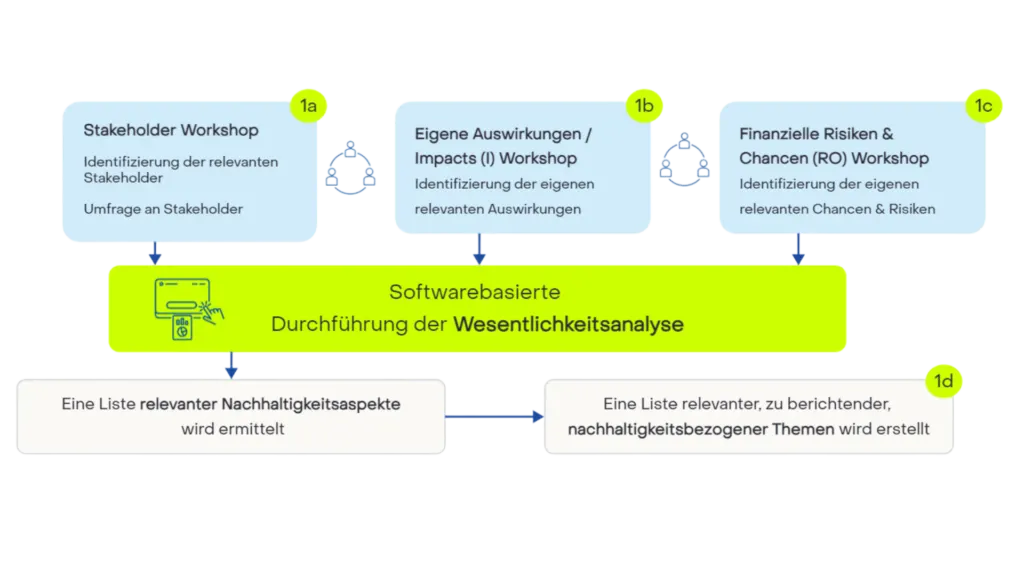
A detailed description of the Code Gaia approach with informative visualizations can be found in our white paper The Code Gaia approach to double materiality.
- EFRAG, Implementation guidance for materiality assessment, 2023 ↩︎
You can also listen to this podcast episode with Stefanie Höpler in conversation with Code Gaia CEO Markus Adler.
You are currently seeing a placeholder content of Standard. To access the actual content, click on the button below. Please note that data will be passed on to third-party providers.
Unlock content Accept required service and unblock content More information